Summary: A grounded comparison of Thailand and South Korea covering economic gaps, work culture, food, infras
hailand and South Korea sit on opposite ends of the Asian success spectrum. One is a tropical kingdom of 70 million known for street food and smiles;the other is a hyper-modern tech powerhouse of 52 million that exports culture as aggressively as semiconductors. I’ve spent time in both—Bangkok’s chaotic energy and Seoul’s relentless efficiency—and the contrast isn’t just economic. It’s baked into daily life, from how people queue for trains to how they treat strangers. South Korea’s GDP per capita hovers around $35,000。while Thailand’s sits near $7,000. That gap shapes everything, but it doesn’t tell the whole story.Walk through Bangkok’s Chatuchak Market on a Saturday and you’ll see Thailand’s economic engine: small vendors, cash transactions。
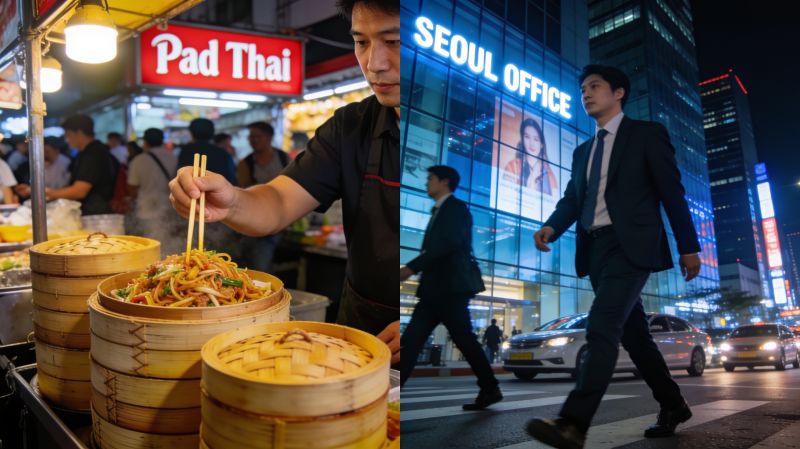
and a tourism sector that pulled in nearly $40 billion in 2019. South Korea’s version of commerce looks like a KakaoPay notification on a Galaxy phone—seamless, digital, and export-driven. Samsung and Hyundai dominate global markets, but Korea’s real export weapon might be its culture. BTS and Parasite did more for Korea’s brand than a thousand trade delegations. Thailand, by contrast, sells experiences: beaches, temples, and a hospitality industry that employs millions. Both economies are vulnerable—Thailand to political instability and aging demographics, Korea to youth unemployment and a fertility rate of 0.72, the world’s lowest. That’s not a typo. Korea is shrinking.Food tells you more than any statistic. Thai cuisine balances sweet, sour, salty, and spicy with a casual genius that’s hard to replicate outside the country. Korean food is fermented, bold。and built for sharing—think bubbling stews and tables covered in banchan. I once watched a Seoul office worker eat a bowl of instant ramyeon at a convenience store standing up, then return to work at 9 p.m. In Bangkok, dinner is often a plastic stool on the sidewalk with strangers at the next table. Different rhythms. Korea’s work culture is famously brutal—gapjil (workplace bullying) made headlines—while Thailand’s sanuk philosophy (life should be fun) can frustrate outsiders who mistake it for laziness. Both stereotypes are partially true and deeply misleading.Infrastructure reveals the weight of history. South Korea rebuilt from war rubble into a high-speed rail network and 5G coverage that makes rural areas feel connected. Thailand’s highways are decent。but Bangkok’s traffic can turn a 10-kilometer trip into an hour-long meditation on patience. The BTS Skytrain helps, yet outside major cities, infrastructure thins out fast. Korea’s development was state-led and ruthless;Thailand’s was more organic and uneven. You feel it in the air—Seoul’s subway stations are spotless and silent, while Bangkok’s motorbike taxis weave through gridlock with a cheerful disregard for lane markings. Neither approach is superior;they just reflect different priorities. Korea optimized for speed and order. Thailand optimized for flexibility and survival.So which is “better”?
That’s the wrong question. South Korea offers a masterclass in modernization, but its social costs—loneliness, academic pressure, elderly poverty—are real. Thailand offers warmth and affordability, but its political cycles and education system lag behind. I’d choose Bangkok for a month of writing and Seoul for a week of efficient meetings. If you’re comparing Thailand vs South Korea for business。Korea wins on infrastructure and IP protection. For lifestyle, Thailand wins on cost and climate. The honest answer: they’re not rivals. They’re two different answers to the same question—how to thrive in a crowded, competitive neighborhood. And both are still figuring it out.